Strategy & Design

Every product is a promise.

And I make sure that promise holds: putting the user back at the center, getting internal teams to own the mission, and never losing sight of the numbers.

What I Believe.

People don't stay because a product is cheapest or most powerful—they stay when it reflects who they are. Product loyalty is covenantal; the brand promises to reflect audience values and beliefs, and the audience responds with dedication and trust. My teams align promises with expectations, creating relationships that last.

I came to that belief honestly: through fifteen authored books on design, an MFA from Bard, a fellowship from Yale, and years building practices from scratch and running national organizations.

I can support engineering timelines and business pressure without letting design leave the conversation. I hold the room when it matters, and I still care how the work actually lands.

Results

If it didn’t move a number, what was it for?

100M+

Arity- Grew MAU reach through partnerships with Experian, SiriusXM, & Alarm.com

+280%

Champion Gaming- Subscriber growth after product and funnel redesign

0370

Wipro Digital- UX practice team growth as foundational design employee #1

$41B

Sears Holdings- in-store sales impact by increasing personalization email CTR by 600%

Case Studies

Strategy in action

How I read the situation and what I did about it.

Arity
Prototype gallery Screens from the Arity pipeline.
1/1 Click to expand

The Problem

Arity had built its business on insurance — a trillion miles of driving data turned into behavioral risk scores, telematics, and ZIP-level pricing. But that data was valuable well beyond a single market. Consumer apps, connected home, automotive entertainment — all of them could use driving intelligence, but Arity had no presence, no products shaped for those audiences, and no relationships in the room.

The Approach

I identified how Arity's data needed to be positioned differently for each new market and led the team that built the product experiences and sales materials to match. On the product side, we owned the experience layer for the SDK and mobile publishing platform. On the sales side, we created the prototypes and demo experiences that helped open new markets. For Experian, I led the definition of "Arity Test Drive," a sign-up flow targeted at their 30–80M subscribers that created the perfect audience for Arity's network of 30+ insurance carriers. For Alarm.com and SiriusXM, the work centered on how our SDK would integrate into their apps for crash detection, safety alerts, and family monitoring across hundreds of white-label partners.

The Method

I built a prototyping workflow around AI that got us from concept to working demo in days instead of weeks. I started with the strategic concept, used generative tools to get initial design patterns on screen, refined those, and brought everything into code as a functional prototype. Then I pulled from actual data — internal decks, raw telemetry, Confluence docs — and built out realistic data models so sales had something real to put in front of a prospect and product had a POC they could actually react to. I used this approach on Arity Geosight, which measured road-segment driving behavior for ZIP-level insurance pricing, and Arity RTA, which mapped dynamic trade areas and point-to-point journey behavior for retail and quick-serve markets.

The Outcome

The design strategy and dynamic prototypes were central in establishing these new client relationships. Experian opened access to 30–80M app users. Alarm.com/ADT brought 10M MAU and 1,600+ white-label partners. SiriusXM opened a path to 110M+ users through Pandora, with OEM expansion through Stellantis.

Champion Gaming
Product screens EdjSports and Football Outsiders.
1/1 Click to expand

The Problem

Champion Gaming had a sports analytics product with a loyal audience that wasn't growing. The interface had been built by engineers for power users — dense, functional, hard to love. The subscription funnel leaked badly. Engagement was flat. The challenge was clear: grow the subscriber base and revenue without alienating the diehards who already depended on it.

The Approach

I rebuilt the subscription funnel by cutting the steps in half and making it clear what each tier offered. Then I redesigned the analytics platform so new users could get something useful in two minutes without losing the depth that the core audience depended on.

The Outcome

Subscribers grew 280%. Revenue increased 20% year-over-year. Pageviews jumped 206%, session duration rose 279% — people were actually staying. The media and betting partnerships gave us reach we'd never had.

NielsenIQ

The Problem

Nielsen was splitting in two — a $6B divestiture. The consumer intelligence side was becoming NielsenIQ, an independent company. The product portfolio was sprawling: over 100 enterprise applications built or acquired over decades, no shared design language, duplicated features everywhere, inconsistent branding. Thousands of global clients in CPG, retail, and media depended on these tools every day. All of it had to be rebranded and brought into alignment while the company was being torn in half.

The Approach

I ran a 20-person org across design, UX, and research. First I overhauled the design system — modular code snippets, flexible design tokens, a shared repository that worked from design through to front-end dev. Then I connected with my VP counterparts in branding and corporate marketing and proposed a cross-functional governance body I called the Nielsen Design Collective. The CMO approved it and we presented to the board. From there we audited the full ecosystem, ran weekly sessions over several months to communicate the new standards, answer questions, and hand off changes to local app teams. Final step was inspecting what we expected — signoffs, decisions on the outliers, and making sure it stuck.

The Outcome

Design system overhaul was done by mid-June. The Nielsen Design Collective had CMO approval and a board presentation by July. Weekly rollout sessions ran through the fall — communicating standards, answering questions, assigning changes to local app teams across the full ecosystem. Final signoffs came in January. Twelve months, start to finish, 100+ applications unified under a single design language serving 40% of global retail distribution. The design org came through the divestiture intact and functioning.

Design Examples

Process and outcomes

A closer look at how the work actually gets made — and the artifacts it leaves behind.

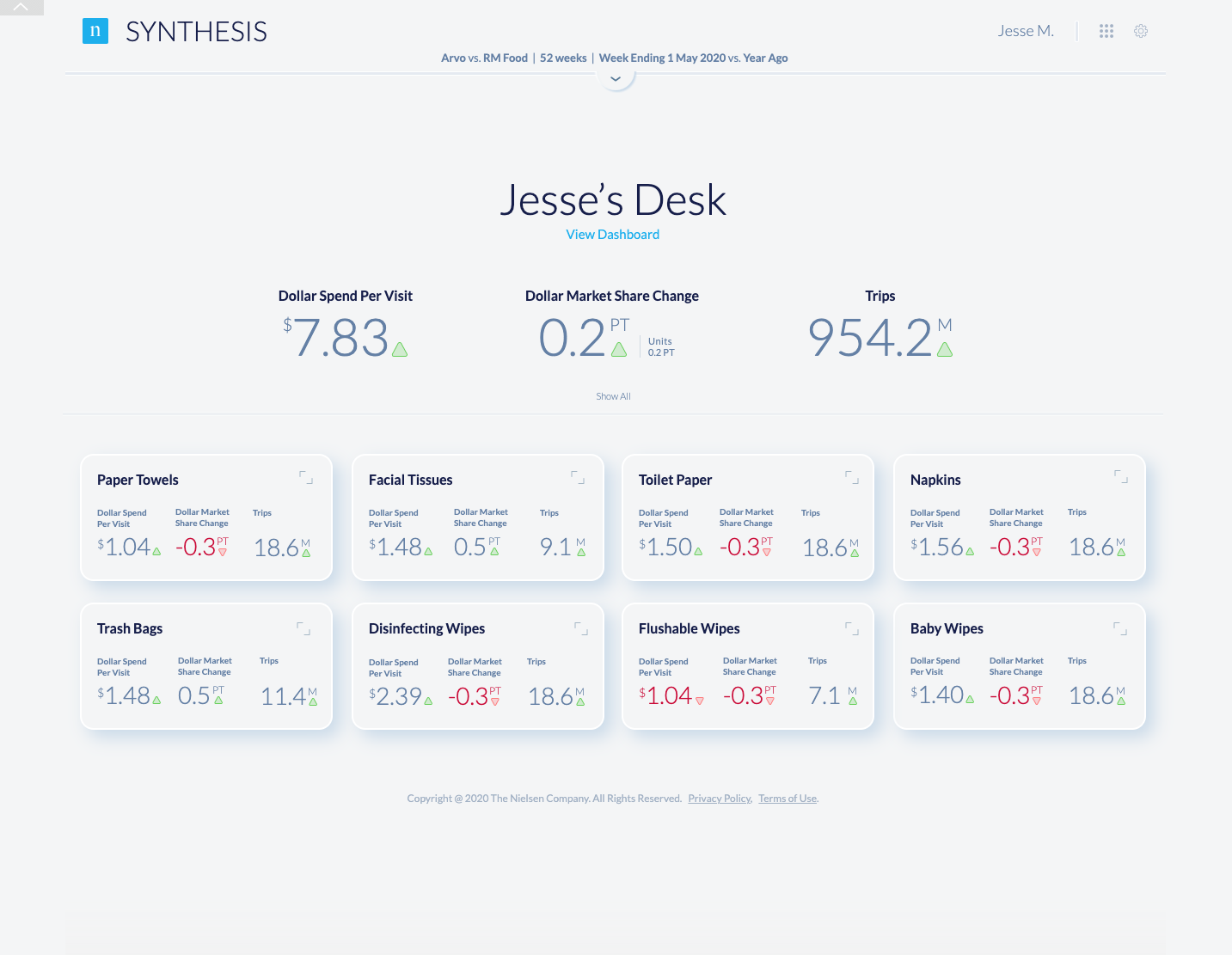
Synthesis dashboard — Jesse's Desk overview screen with category cards and key metrics

Synthesis Turning a six-billion-dollar dashboard
into a decision workspace

A workshop example from NielsenIQ on how the redesign got shaped — pre-work, team friction, concepting past the safe answer, and the final visual outcome. Plus a "then vs. AI today" pass on how AI changes the pace and quality of the work.

Practice

AI and the promise of repeatable genius

AI isn't about speed. It's the unspoken promise of the unexpected.

AI changes how we work, and above all how we create. It isn't only a speed play. When you use it with intent, it makes the work better: more exploration, more iteration, more ways to get past the first obvious answer. The catch is discipline. You have to push through what looks good enough, revisit, combine, scrap, and keep going until the output matches the criteria you actually care about.

The shift everyone is waiting for isn't fully here yet, but as we all know, it's coming. When it lands, the business impact won't mainly be about who ships faster. It will be about who holds a higher bar on quality and innovation. We used to excuse a lower bar because talent, time, and money were scarce. That excuse is weaker now. The cost of exploring and refining has dropped. The organizations that treat AI as permission to iterate, not as a shortcut to the first solution, will pull ahead.

Where AI helps, and what you still own

Phase
Where AI helps
What people still own
Project parameters
Pulls in constraints, precedent, and analogous work fast, so you are not staring at a blank wall.
Naming the problem, the audience, and what would actually count as a win. The model can’t infer that from an empty brief.
Success criteria
Spells out metrics, pokes at them, and surfaces blind spots you might not have named yet.
Keeping the bar honest: what users need, what the business can stand behind, and where those two have to meet.
Exploration
Opens branches you would not have time to draw by hand: different aesthetics, odd combinations, directions you might not have walked alone.
Understanding the creative trajectory and separating signal from noise.
Refinement
Keeps throwing alternatives and what-ifs until you call it off. Volume without the all-nighter.
Knowing what to keep, what to combine, and what to let go requires a human grasp of the core concept, the brand message, and the development cadence.
Polish
Speeds up execution and the pixel-level pass once direction is clear.
Final scrutiny as the stakeholder. Slow down, step away, come back with fresh eyes, and revise until it holds up.

The discipline to be undisciplined

Working with AI requires a discipline that is less about being definitive and more about staying curious. Don’t walk in with the answer already chosen. Walk in with the criteria: the KPIs, constraints, audience, and business outcome the work has to satisfy.

When the first viable answer appears, take it seriously, but don’t stop there. Use it as a springboard. The opportunity is not to generate endlessly; it’s to keep the work open long enough for a better answer to emerge.

What not to do

Don't freeze the workflow. Everything is changing too quickly. Keep the way you work open to revision.

Don't outsource the judgment. AI generates options. People make the call on what holds up.

Don't mistake volume for progress. More drafts only matter if they sharpen the decision.

Don’t treat AI as a separate practice. Anchor it to the brand and business strategy. Those are the guardrails everything else has to honor.

Approach

How I lead

What holds up, no matter where I go.

Align and extend

Every engagement starts the same way: get the business priorities, team capabilities, and product reality lined up before you commit to a direction. I've walked into a 100-app ecosystem at Nielsen that had no standard, 8 competing brand experiences at Foot Locker, three acquired studios at Publicis — and the first job is never "start designing." It's getting everyone pointed in the same direction.

Align, then extend

Wipro / US Bank

The problem: A $46M, three-year engineering plan with one UX designer embedded downstream, and a March launch already on the calendar.

The move: Six weeks and $48K to build an experience model as proof that the product direction could hold.

The result: Delivered in late January, loved by the client, and converted into $3M in UX project work that kept a team busy for three years.

That's the pattern. Align first, then extend the trajectory. Think of a space capsule's reentry — the angle has to be exactly right. Too steep and you burn up. Too shallow and you skip off into nothing. Get it right, and the rest of the path takes care of itself.

The org has to outlast you

At Wipro I was hired to build a UX practice from nothing — process, service models, pricing, team structure, hiring, budgets, revenue. When I left we were nearly 400 people. At AOL I grew the team from 7 to 36. At Publicis I ran 76 across 9 offices. I don't build teams around people. I build them around shared convictions — why the work matters, not just how it gets done. When those hold, the team holds — whether I'm there or not.

Career

Where I've been

2023 — 2026 Director, Design Lead Arity (Allstate) — Defined the product and go-to-market strategy for Arity's expansion beyond insurance, leading design across both the product org (SDK, mobile publishing) and sales (prototypes, demo experiences) for new partnerships including Experian, Alarm.com, and SiriusXM.
2021 — 2022 VP, Product Design & Dev Champion Gaming — Re-architected product and subscription funnel, driving +280% subscriber growth and +20% YOY revenue.
2019 — 2021 VP, User Experience NielsenIQ (Nielsen) — Led 20-person global design org through $6B divestiture, unifying 100+ enterprise apps supporting 40% of global retail distribution.
2017 — 2019 Senior Director, UX & Product Foot Locker — Led 12-person UX org across 8 global retail brands, increasing conversion +7% through checkout redesign.
2014 — 2016 Digital Practice Partner Wipro Digital — Built global UX practice from 0 to ~370 as employee #1 for design. Secured $3M+ engagement via strategic reframing.
2012 — 2013 SVP / Partner, CX Rosetta (Publicis Groupe) — Led UX nationally across 9 offices, 76 people. Unified UX culture across three acquired studios post-acquisition. ~25% pitch close rate across 43 presentations in the first year.
2008 — 2012 Director, Customer Experience Sears Holdings — R&D team reporting to Chairman Lampert. Sears Catalogue app drove 20% online revenue growth influencing $41B in-store sales.
2007 — 2008 Creative Director Razorfish (Microsoft) — Creative direction and eCommerce strategy for P&G, JC Penney, Navteq, DeVry. Key role in winning JC Penney's $25M AOR contract.
2006 — 2007 Interactive Creative Director Coldwater Creek — Led first site redesign in seven years for $1B retailer. +32% pageviews, reduced cart abandonment, 40% online conversion lift YOY. Grew design team 200%.
2001 — 2006 Director, Design AOL (Time Warner) — Defined the content and traffic strategy across Netscape, CompuServe, and AIM. Conceived the Netscape traffic catalyst that drove +4M sessions/mo to CNN. Grew team from 7 to 36.

Let's talk about what you're building.

If your product experience is falling behind your ambition, I can help. Let's talk about what's broken and how to fix it.